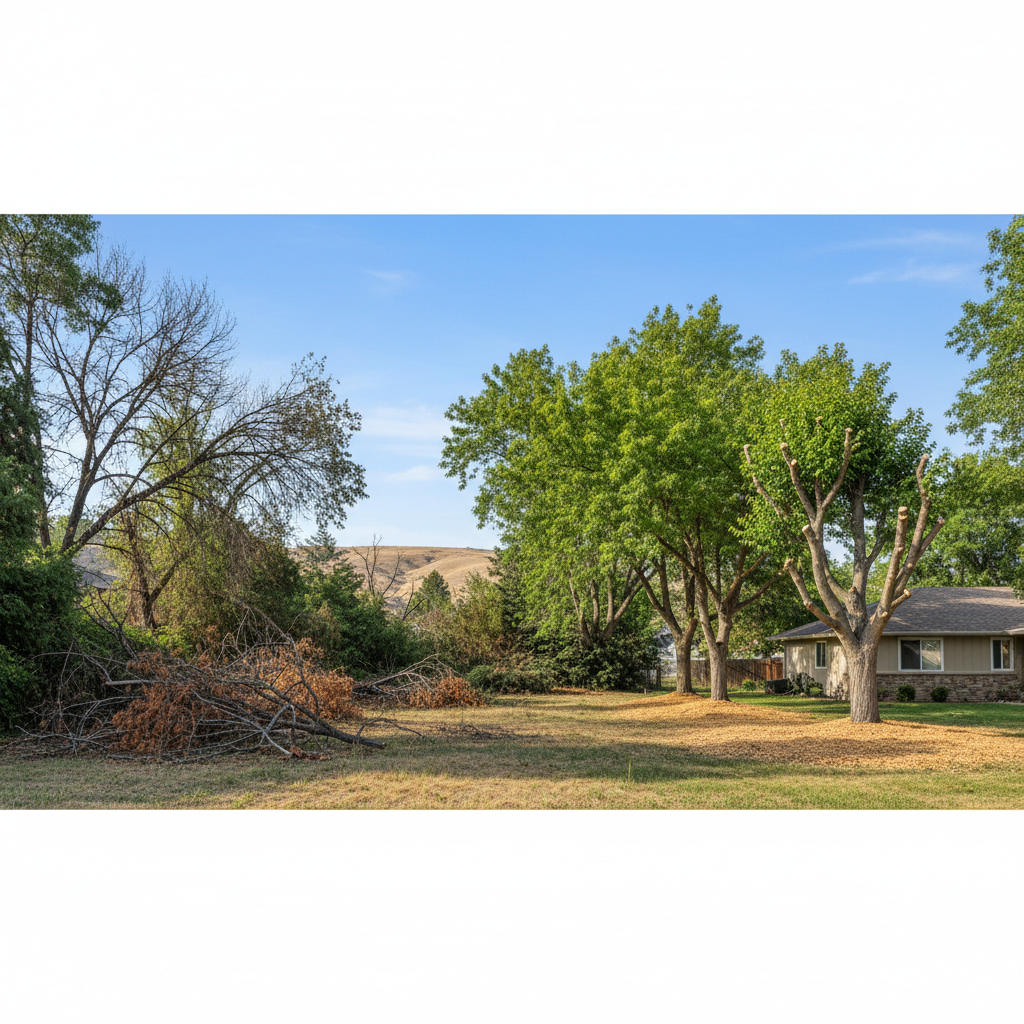
You've got trees on your property, and sooner or later, they're going to need a trim. Maybe they're getting too big, blocking a view, or just looking a little wild. When you start looking into it, you'll hear about a couple of main approaches: 'topping' and 'proper pruning.' Let me tell you straight up, these aren't just two different ways to do the same thing. They're fundamentally different, and one is almost always a bad idea.
I've been in the tree service business here in Richland for a long time, and I've seen the good, the bad, and the ugly when it comes to tree care. Let's talk about what these two methods really mean for your trees, your property, and your wallet.
What is Tree Topping?
Tree topping is when someone cuts back a tree's main branches and stems to stubs, often leaving just a few inches or feet. They usually cut between the natural growth points, essentially chopping off the top or large sections of the canopy. It's done to quickly reduce the tree's size, and it might seem like a fast, cheap solution at first glance.
What is Proper Tree Pruning?
Proper pruning, on the other hand, is a much more thoughtful and skilled process. It involves making strategic cuts at specific points, usually just outside the branch collar, to remove dead, diseased, or crossing branches. The goal is to improve the tree's health, structure, and appearance, while maintaining its natural form. Sometimes it's called 'thinning' or 'reduction pruning,' but the key is that the cuts are made with the tree's long-term health in mind.
Cost: Initial vs. Long-Term
Let's talk money, because that's often the first thing folks think about. Initially, topping might seem cheaper. Someone with a chainsaw can come in and hack off a lot of tree in a short amount of time. They don't need much skill or knowledge about tree biology.
But here's the kicker: that initial savings is almost always a false economy. Topped trees react by sending out a flush of weak, fast-growing shoots from the cut stubs. These shoots are often called 'water sprouts' or 'suckers.' They grow back incredibly fast, sometimes even faster than the original growth, and they're poorly attached to the main branch. This means you'll need to have the tree topped again, sooner than you'd think, and often more frequently. So, your long-term maintenance costs go way up.
Proper pruning costs more upfront because it requires skilled arborists who understand tree biology and growth patterns. They take their time, make precise cuts, and know what they're doing. But because these cuts promote healthy, strong growth, your tree will stay healthier longer, require less frequent maintenance, and be more resilient. Over five or ten years, proper pruning almost always ends up being the more cost-effective choice.
Durability and Tree Health
This is where the differences really become stark. Topping is incredibly damaging to a tree's health and structure. When you cut off large branches indiscriminately, you're removing a huge portion of the tree's food-producing leaves. This stresses the tree out big time, making it vulnerable to insects, diseases, and sun scald. Those weak water sprouts I mentioned? They're prone to breaking in high winds or under the weight of snow and ice – and we get some decent winds and occasional ice storms here in the Tri-Cities, especially out in the Badger Mountain area where homes are more exposed. A topped tree is a structurally compromised tree, and that's a safety hazard.
Proper pruning, done correctly, actually improves a tree's health. By removing dead or diseased wood, you prevent the spread of decay. By thinning the canopy, you improve air circulation and light penetration, which can reduce disease risk. Strategic cuts encourage strong branch development, making the tree more resilient to weather events. A properly pruned tree is a happy, healthy, and durable tree.
Maintenance Requirements
As I touched on with cost, topped trees become high-maintenance nightmares. Because they respond with that burst of weak growth, you'll be looking at another topping job within a year or two, sometimes even sooner. It's a vicious cycle that just keeps weakening the tree and increasing your bills.
Properly pruned trees, on the other hand, usually only need attention every 3-5 years, depending on the species and its growth rate. The goal is to set the tree up for long-term health, not to create a recurring problem.
Appearance
Let's be honest, a topped tree looks terrible. It's often described as 'hat-racked' or 'lion-tailed' because of the stubs and the bushy growth that erupts from them. It destroys the tree's natural shape and beauty. If you've invested in landscaping or just appreciate the aesthetics of a well-grown tree, topping will ruin that in a hurry.
Proper pruning maintains and even enhances a tree's natural form. It keeps the tree looking balanced, healthy, and beautiful, adding to your property's curb appeal and value. Think about the beautiful shade trees you see in established neighborhoods around Richland – those have been cared for with proper pruning, not topping.
My Recommendation for Richland Homeowners
For homeowners in Richland, WA, my recommendation is always, always, always proper pruning. I know it might cost a little more upfront, but it's an investment in the health, safety, and beauty of your trees and your property. Topping is a short-sighted approach that creates more problems than it solves, often leading to tree decline, increased costs, and even tree removal down the line.
When you're looking for someone to work on your trees, make sure they understand and practice proper pruning techniques. Ask them about their methods, and if they start talking about 'topping' as a solution, politely thank them and call someone else. Your trees are a valuable asset, and they deserve proper care. If you've got questions or need a hand with your trees, don't hesitate to give Richland Tree Service a call. We're here to help you keep your trees healthy and strong for years to come.